More services available in PSN's secure cloud Opens in a new tab

PSN is being updated and enriched with services that enable public administrations to adopt innovative technological solutions.


The framework to accompany PA from cloud migration to secure, sustainable and coordinated management of digital infrastructure.
The Italian Cloud Strategy guides the digital transformation of public administrations towards secure, efficient, and sustainable cloud infrastructures. It establishes which data and services to migrate, how to choose qualified solutions, and when to use the National Strategic Hub or local data centers. The goal is to guarantee the country's digital sovereignty and protect the most critical services for citizens and public bodies.
Since 2021, it has supported public administrations on this journey, from initial migration to the evolution of applications and digital infrastructures with innovative technologies.

STRATEGIC OBJECTIVES
How to update systems and applications?
To overcome technological debt, that is, the burden of outdated or suboptimal technical solutions accumulated over time, applications are being rethought from a cloud-native perspective and integrated with emerging technologies such as artificial intelligence.
How to make spending sustainable?
Administrations are adopting economic cloud management practices designed for the public sector: tools that help plan costs, monitor consumption, and optimize resources over time without waste.
How to build a federated and sovereign cloud?
The Cloud Italy Strategy links territorial data centers and the National Strategic Hub into a coordinated and interoperable system. Thus digital services are closer to the citizenry and public data remain under national control.
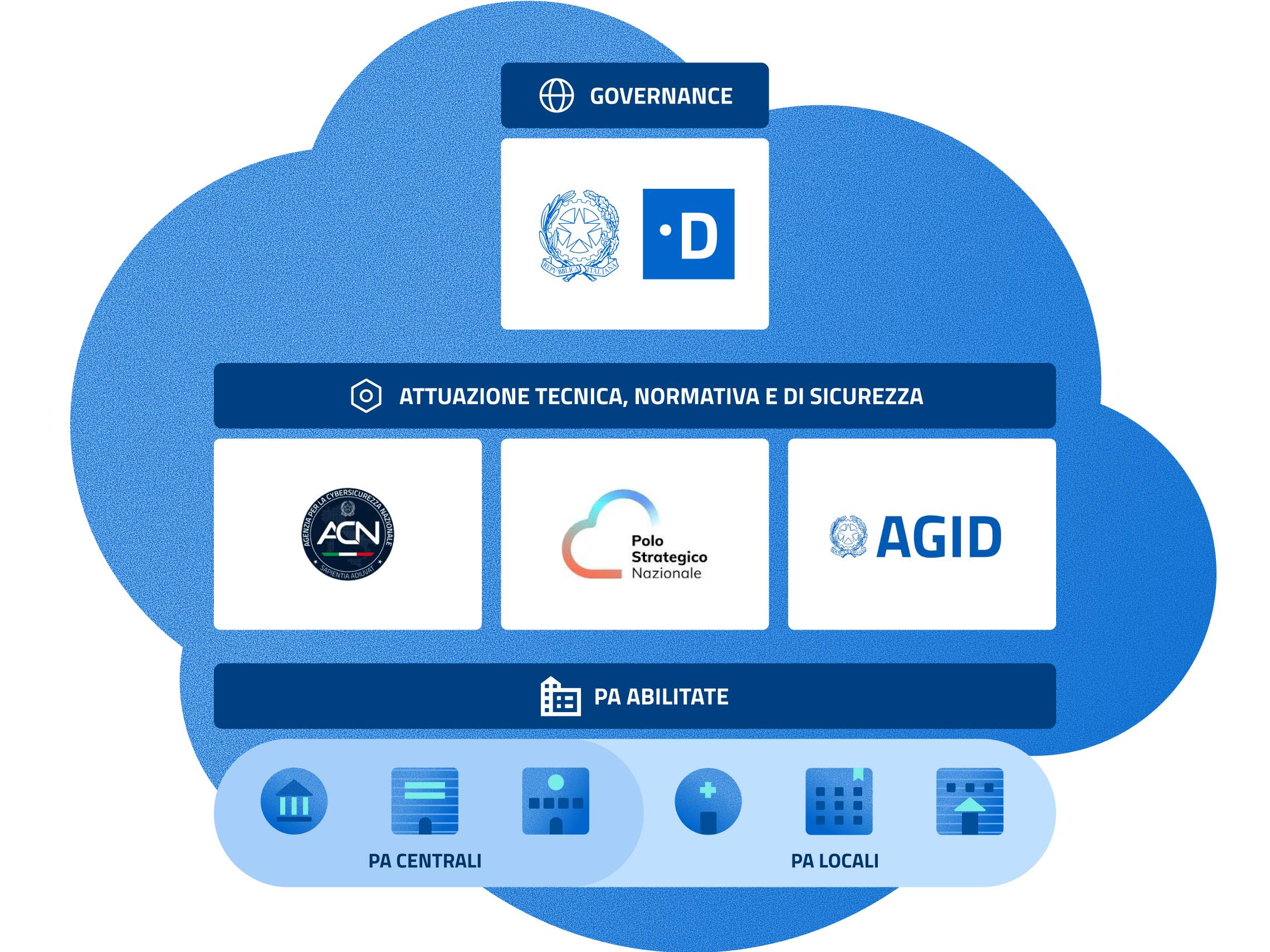
The governance of the Italian Cloud Strategy is based on distinct and coordinated roles:
After the most intense migration phase, work is focused on consolidating the results and continuing the modernization and digitalization of public administration services.
BROWSE THE AREAS OF EVOLUTION
Complete cloud migration paths and address systems still based on obsolete technologies to reduce technological debt and make public digital services more stable and reliable.
Develop structured models for cloud financial management and support the transition from infrastructure spending to recurring spending, adopting practices inspired by the FinOps framework to monitor and optimize costs, consumption, and service levels.
Valuing the Polo Strategico Nazionale and qualified local data centres within a distributed and interoperable cloud model. The establishment of qualified edge nodes enables low-latency services and supports new forms of innovation in public administration digital services.
The Cloud Italia Strategy is part of a common path toward a European digital sovereignty.
PSN is being updated and enriched with services that enable public administrations to adopt innovative technological solutions.

Collaborative ecosystem kicks off to accelerate digital transformation of public administration

Let us review the "toolbox" of digital identity systems that enable the delivery of public services
PSN is being updated and enriched with services that enable public administrations to adopt innovative technological solutions.
Collaborative ecosystem kicks off to accelerate digital transformation of public administration
Let us review the "toolbox" of digital identity systems that enable the delivery of public services
The Cloud Italia Strategy is coordinated by the Dipartimento per la trasformazione digitale of the Presidenza del Consiglio dei Ministri (DTD), which defines strategic direction and monitors implementation. Coordination is carried out in close collaboration with the Agenzia per la Cybersicurezza Nazionale (ACN) for security aspects, the Agenzia per l’Italia Digitale (AGID) for interoperability, and operational entities such as the Polo Strategico Nazionale (PSN).
Administrations that have yet to migrate to the cloud can plan the first steps and choose the cloud model that works best for their data and services. A good place to start is to follow the guidance in Preparing for Migration.
Governments need to integrate the cloud into routine budget planning and treat it as a recurring expense item, not just an extraordinary investment. To maintain control over time, it is useful to adopt economic governance models and tools, such as practices inspired by the FinOps framework, that allow costs and consumption to be monitored and evaluated against the quality of service and benefits generated.
The Polo Strategico Nazionale is the cloud infrastructure dedicated to hosting the most critical and strategic public services. Within the Italy Cloud Strategy, it guarantees high levels of security, business continuity and data control. In addition to this, it offers administrations a reliable and compliant environment on which to migrate and manage their digital services.
We have gathered all the practical information in the Guides section where you can find the operational support you need at every stage: from migration to management to service evolution.